
![High School Geometry Cheat Sheet [Printable PDF Included]](https://thehighschooler.net/wp-content/uploads/2026/10/Geometry-Cheat-Sheet.jpg)
Geometry has a lot to remember: angle rules, triangle theorems, circle properties, area and volume formulas, and the reasons you need for proofs.
It’s easy to mix them up right when you need them. This post puts everything in one place, from angles and triangles to circles, coordinate geometry, transformations, and proofs.
Each section below matches what’s on the cheat sheet, so you can study from this page now and keep the PDF for quick reference later.
Scroll to the end to grab the printable PDF, designed to print front and back on a single sheet.
What’s Inside
Front side
2. Triangles
3. Right Triangles and Trigonometry
4. Polygons and Quadrilaterals
Back side
5. Circles
7. Area, Surface Area, and Volume
The Cheat Sheet, Section by Section
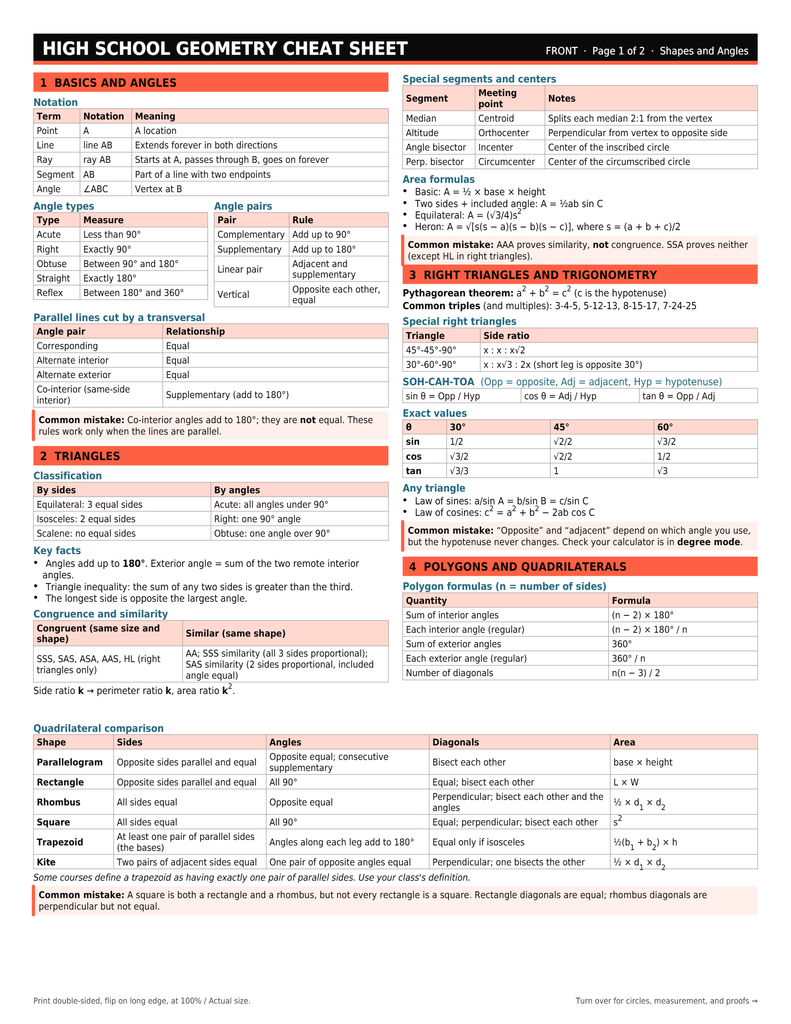
Front Side (Page 1): Shapes and Angles
1. Basics and Angles
Notation
| Term | Notation | Meaning |
|---|---|---|
| Point | A | A location |
| Line | line AB | Extends forever in both directions |
| Ray | ray AB | Starts at A, passes through B, goes on forever |
| Segment | AB | Part of a line with two endpoints |
| Angle | ∠ABC | Vertex at B |
Angle types
| Type | Measure |
|---|---|
| Acute | Less than 90° |
| Right | Exactly 90° |
| Obtuse | Between 90° and 180° |
| Straight | Exactly 180° |
| Reflex | Between 180° and 360° |
Angle pairs
| Pair | Rule |
|---|---|
| Complementary | Add up to 90° |
| Supplementary | Add up to 180° |
| Linear pair | Adjacent and supplementary |
| Vertical angles | Opposite each other and equal |
Parallel lines cut by a transversal
| Angle pair | Relationship |
|---|---|
| Corresponding | Equal |
| Alternate interior | Equal |
| Alternate exterior | Equal |
| Co-interior (same-side interior) | Supplementary (add to 180°) |
Common mistake: Co-interior angles add to 180°; they are not equal. Also, these rules only work when the lines are parallel.
2. Triangles
Classification
| By sides | By angles |
|---|---|
| Equilateral: 3 equal sides | Acute: all angles under 90° |
| Isosceles: 2 equal sides | Right: one 90° angle |
| Scalene: no equal sides | Obtuse: one angle over 90° |
Key facts
- Angles add up to 180°.
- Exterior angle = the sum of the two remote interior angles.
- Triangle inequality: the sum of any two sides is greater than the third.
- The longest side is opposite the largest angle.
Congruence and similarity
| Congruent (same size and shape) | Similar (same shape) |
|---|---|
| SSS, SAS, ASA, AAS, HL (right triangles only) | AA, SSS similarity (all three sides proportional), SAS similarity (two sides proportional, included angle equal) |
If the side ratio is k, the perimeter ratio is k and the area ratio is k².
Special segments and centers
| Segment | Meeting point | Notes |
|---|---|---|
| Median | Centroid | Splits each median 2:1 from the vertex |
| Altitude | Orthocenter | Perpendicular from vertex to opposite side |
| Angle bisector | Incenter | Center of the inscribed circle |
| Perpendicular bisector | Circumcenter | Center of the circumscribed circle |
Area formulas
- Basic: A = ½ × base × height
- Two sides and the included angle: A = ½ab sin C
- Equilateral: A = (√3/4)s²
- Heron’s formula: A = √[s(s − a)(s − b)(s − c)], where s = (a + b + c)/2
Common mistake: AAA proves similarity, not congruence. SSA proves neither (except HL in right triangles).
3. Right Triangles and Trigonometry
Pythagorean theorem: a² + b² = c² (c is the hypotenuse)
Common triples (and their multiples): 3-4-5, 5-12-13, 8-15-17, 7-24-25
Special right triangles
| Triangle | Side ratio |
|---|---|
| 45°-45°-90° | x : x : x√2 |
| 30°-60°-90° | x : x√3 : 2x (short leg is opposite 30°) |
SOH-CAH-TOA
- sin θ = Opposite / Hypotenuse
- cos θ = Adjacent / Hypotenuse
- tan θ = Opposite / Adjacent
Exact values
| θ | 30° | 45° | 60° |
|---|---|---|---|
| sin | 1/2 | √2/2 | √3/2 |
| cos | √3/2 | √2/2 | 1/2 |
| tan | √3/3 | 1 | √3 |
Any triangle
- Law of sines: a/sin A = b/sin B = c/sin C
- Law of cosines: c² = a² + b² − 2ab cos C
Common mistake: “Opposite” and “adjacent” depend on which angle you’re using, but the hypotenuse never changes. Also check that your calculator is in degree mode.
4. Polygons and Quadrilaterals
Polygon formulas (n = number of sides)
| Quantity | Formula |
|---|---|
| Sum of interior angles | (n − 2) × 180° |
| Each interior angle (regular) | (n − 2) × 180° / n |
| Sum of exterior angles | 360° |
| Each exterior angle (regular) | 360° / n |
| Number of diagonals | n(n − 3) / 2 |
Quadrilateral comparison
| Shape | Sides | Angles | Diagonals | Area |
|---|---|---|---|---|
| Parallelogram | Opposite sides parallel and equal | Opposite equal; consecutive supplementary | Bisect each other | base × height |
| Rectangle | Opposite sides parallel and equal | All 90° | Equal; bisect each other | L × W |
| Rhombus | All sides equal | Opposite equal | Perpendicular; bisect each other and the angles | ½ × d₁ × d₂ |
| Square | All sides equal | All 90° | Equal; perpendicular; bisect each other | s² |
| Trapezoid | At least one pair of parallel sides (the bases) | Angles along each leg add to 180° | Equal only if isosceles | ½(b₁ + b₂) × h |
| Kite | Two pairs of adjacent sides equal | One pair of opposite angles equal | Perpendicular; one bisects the other | ½ × d₁ × d₂ |
Some courses define a trapezoid as having exactly one pair of parallel sides. Use your class’s definition.
Common mistake: A square is both a rectangle and a rhombus, but not every rectangle is a square. Rectangle diagonals are equal; rhombus diagonals are perpendicular but not equal.
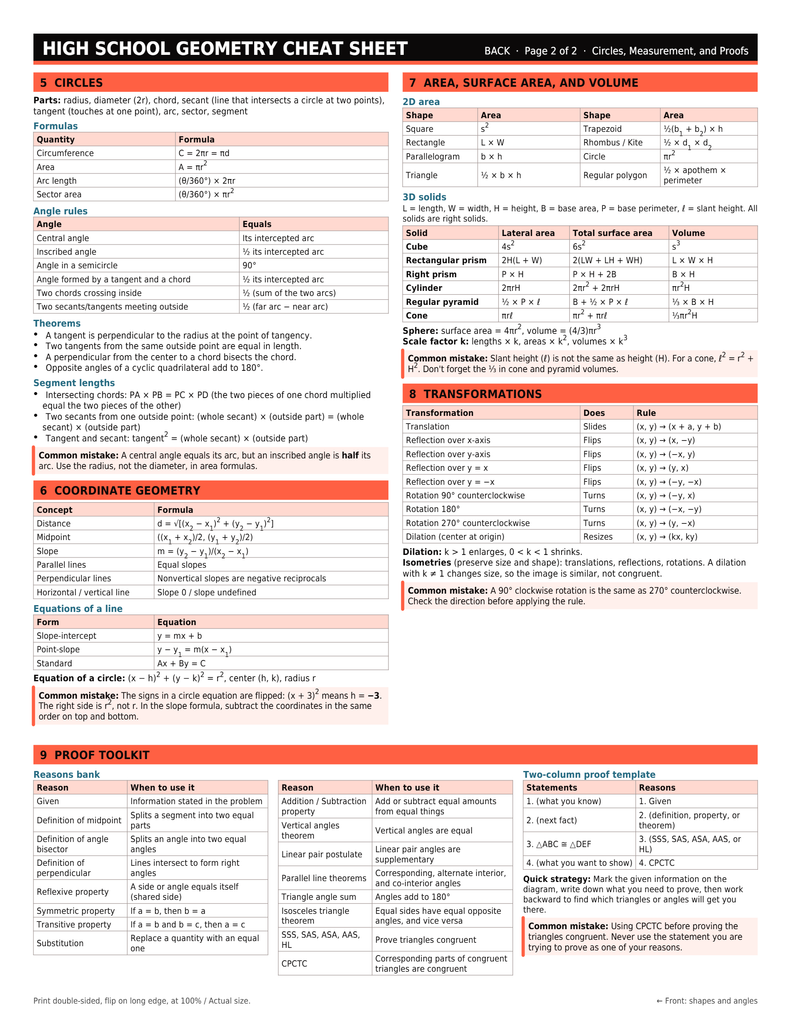
Back Side (Page 2): Circles, Measurement, and Proofs
5. Circles
Parts: radius, diameter (2r), chord, secant (line through two points), tangent (touches at one point), arc, sector, segment
Formulas
| Quantity | Formula |
|---|---|
| Circumference | C = 2πr = πd |
| Area | A = πr² |
| Arc length | (θ/360°) × 2πr |
| Sector area | (θ/360°) × πr² |
Angle rules
| Angle | Equals |
|---|---|
| Central angle | Its intercepted arc |
| Inscribed angle | ½ its intercepted arc |
| Angle in a semicircle | 90° |
| Angle formed by a tangent and a chord | ½ its intercepted arc |
| Two chords crossing inside | ½ (sum of the two arcs) |
| Two secants/tangents meeting outside | ½ (far arc − near arc) |
Theorems
- A tangent is perpendicular to the radius at the point of tangency.
- Two tangents from the same outside point are equal in length.
- A perpendicular from the center to a chord bisects the chord.
- Opposite angles of a cyclic quadrilateral add to 180°.
Segment lengths
- Intersecting chords: PA × PB = PC × PD (the two pieces of one chord multiplied equal the two pieces of the other)
- Two secants from one outside point: (whole secant) × (outside part) = (whole secant) × (outside part)
- Tangent and secant: tangent² = (whole secant) × (outside part)
Common mistake: A central angle equals its arc, but an inscribed angle is half its arc. Also, make sure you use the radius, not the diameter, in area formulas.
6. Coordinate Geometry
| Concept | Formula |
|---|---|
| Distance | d = √[(x₂ − x₁)² + (y₂ − y₁)²] |
| Midpoint | ((x₁ + x₂)/2, (y₁ + y₂)/2) |
| Slope | m = (y₂ − y₁)/(x₂ − x₁) |
| Parallel lines | Equal slopes |
| Perpendicular lines | Slopes multiply to −1 (negative reciprocals) |
| Horizontal / vertical line | Slope 0 / slope undefined |
Equations of a line
| Form | Equation |
|---|---|
| Slope-intercept | y = mx + b |
| Point-slope | y − y₁ = m(x − x₁) |
| Standard | Ax + By = C |
Equation of a circle: (x − h)² + (y − k)² = r², with center (h, k) and radius r
Common mistake: The signs in a circle equation are flipped: (x + 3)² means h = −3. The right side is r², not r. In the slope formula, subtract the coordinates in the same order on top and bottom.
7. Area, Surface Area, and Volume
2D area
| Shape | Area |
|---|---|
| Square | s² |
| Rectangle | L × W |
| Parallelogram | b × h |
| Triangle | ½ × b × h |
| Trapezoid | ½(b₁ + b₂) × h |
| Rhombus / Kite | ½ × d₁ × d₂ |
| Circle | πr² |
| Regular polygon | ½ × apothem × perimeter |
3D solids (L = length, W = width, H = height, B = base area, P = base perimeter, ℓ = slant height; all solids are right solids)
| Solid | Lateral area | Total surface area | Volume |
|---|---|---|---|
| Cube | 4s² | 6s² | s³ |
| Rectangular prism | 2H(L + W) | 2(LW + LH + WH) | L × W × H |
| Right prism | P × H | P × H + 2B | B × H |
| Cylinder | 2πrH | 2πr² + 2πrH | πr²H |
| Regular pyramid | ½ × P × ℓ | B + ½ × P × ℓ | ⅓ × B × H |
| Cone | πrℓ | πr² + πrℓ | ⅓πr²H |
Sphere: Surface area = 4πr², Volume = (4/3)πr³
Scale factor k: lengths × k, areas × k², volumes × k³
Common mistake: Slant height (ℓ) is not the same as height (H). For a cone, ℓ² = r² + H². Also, don’t forget the ⅓ in cone and pyramid volumes.
8. Transformations
| Transformation | What it does | Rule |
|---|---|---|
| Translation | Slides | (x, y) → (x + a, y + b) |
| Reflection over x-axis | Flips | (x, y) → (x, −y) |
| Reflection over y-axis | Flips | (x, y) → (−x, y) |
| Reflection over y = x | Flips | (x, y) → (y, x) |
| Reflection over y = −x | Flips | (x, y) → (−y, −x) |
| Rotation 90° counterclockwise | Turns | (x, y) → (−y, x) |
| Rotation 180° | Turns | (x, y) → (−x, −y) |
| Rotation 270° counterclockwise | Turns | (x, y) → (y, −x) |
| Dilation (center at origin) | Resizes | (x, y) → (kx, ky) |
Dilation: k > 1 enlarges, 0 < k < 1 shrinks.
Isometries (preserve size and shape): translations, reflections, rotations. Dilations change size, so the image is similar, not congruent.
Common mistake: A 90° clockwise rotation is the same as 270° counterclockwise. Check the direction before applying the rule.
9. Proof Toolkit
Reasons bank
| Reason | When to use it |
|---|---|
| Given | Information stated in the problem |
| Definition of midpoint | Splits a segment into two equal parts |
| Definition of angle bisector | Splits an angle into two equal angles |
| Definition of perpendicular | Lines form 90° angles |
| Reflexive property | A side or angle is equal to itself (shared side) |
| Symmetric property | If a = b, then b = a |
| Transitive property | If a = b and b = c, then a = c |
| Substitution | Replace a quantity with an equal one |
| Addition / Subtraction property | Add or subtract equal amounts from equal things |
| Vertical angles theorem | Vertical angles are equal |
| Linear pair postulate | Linear pair angles are supplementary |
| Parallel line theorems | Corresponding, alternate interior, and co-interior angles |
| Triangle angle sum | Angles add to 180° |
| Isosceles triangle theorem | Equal sides have equal opposite angles, and vice versa |
| SSS, SAS, ASA, AAS, HL | Prove triangles congruent |
| CPCTC | Corresponding parts of congruent triangles are congruent |
Two-column proof template
| Statements | Reasons |
|---|---|
| 1. (what you know) | 1. Given |
| 2. (next fact) | 2. (definition, property, or theorem) |
| 3. △ABC ≅ △DEF | 3. (SSS, SAS, ASA, AAS, or HL) |
| 4. (what you want to show) | 4. CPCTC |
Quick strategy: Mark the given information on the diagram, write down what you need to prove, then work backward to find which triangles or angles will get you there.
Common mistake: Using CPCTC before proving the triangles congruent. Also, never use the statement you’re trying to prove as one of your reasons.
Top 5 Mistakes to Avoid
These are the errors that cost students the most points. Each one is covered on the cheat sheet.
- Mixing up central and inscribed angles. A central angle equals its arc, but an inscribed angle is half its arc. Also use the radius, not the diameter, in area formulas.
- Using parallel-line rules when the lines aren’t parallel. Corresponding and alternate angles are equal only when the lines are parallel. Co-interior angles add to 180°; they are not equal.
- Proving congruence with AAA or SSA. AAA proves similarity only. SSA proves nothing, except HL in right triangles.
- Confusing slant height with height. In cone and pyramid formulas, ℓ and H are different. For a cone, ℓ² = r² + H². Don’t forget the ⅓ in cone and pyramid volumes.
- Using CPCTC too early. You can use it only after you’ve proven the triangles congruent. Never use the statement you’re trying to prove as a reason.
How to Study With This Cheat Sheet
A cheat sheet only helps if you actually use it. Here are five ways to turn it from a handout into a study tool.
1. Annotate it
Print the sheet and write on it. Notes in your own handwriting stick better than printed text, and they make the sheet match your class.
- Add your teacher’s notation and any theorem names your class uses.
- Circle or highlight the formulas you forget most often.
- Sketch a small diagram next to each theorem. A quick drawing of a tangent meeting a radius, or of a cone with its slant height marked, is easier to recall than a sentence.
- Use one highlighter color per type of mistake (for example, yellow for formulas you forget, pink for rules you mix up).
2. Cover and quiz
Active recall beats rereading.
- Cover the right column of a table and read only the left.
- Say the answer out loud or write it on scrap paper.
- Uncover the column and check yourself.
- Put a small dot next to every item you miss.
Do one section a day, and spend extra time on the dotted items. For the formula-heavy sections (circles, 3D solids, transformations), try the reverse too: cover the left column and name the shape or rule from the formula.
3. Work one problem per section
After reviewing a section, find one homework or textbook problem that uses it. Solve it with the sheet closed, then check your work against the sheet. This shows you the difference between recognizing a formula and being able to use it.
4. Build a weekly review routine
- Day 1 to 5: Review one or two sections a day using cover and quiz.
- Day 6: Go through only the items you dotted during the week.
- Day 7: Try the Top 5 Mistakes list without looking, then check it.
Short, repeated sessions of 10 to 15 minutes work better than one long session the night before a test.
5. Keep it in your binder
Put the sheet in the front pocket or a sheet protector so it’s with you for homework, quizzes, and exam prep. If your teacher allows a reference sheet on tests, your annotated copy is the one to bring (check the rules first).
Download the Printable Geometry Cheat Sheet (PDF)
What you get:
- 2 pages (front and back of one sheet)
- A4 and Letter sizes
- Black-and-white friendly
How to Print Front and Back
- Select double-sided / duplex printing in your print dialog.
- Choose “Flip on long edge” so page 2 isn’t upside down on the back.
- No duplex printer? Print page 1, then reload the same sheet and print page 2 on the back. Or print both pages and tape or glue them back to back.
- Print at 100% / “Actual size” so the text stays readable.
Wrapping Up,
Geometry is easier when you can see every rule in one place. This cheat sheet covers angles, triangles, trigonometry, polygons, circles, coordinate geometry, area and volume, transformations, and proofs. Use it to check your homework, review before a quiz, and spot the mistakes that cost the most points.
Don’t just read it. Annotate it, quiz yourself with the right column covered, and go back to the sections you keep missing. A few minutes a day will help more than one long session the night before a test.

An Engineer, Maths expert, Online Tutor, and animal rights activist. I have more than 5 years of teaching experience and have worked closely with students with learning disorders. I have worked with special educators, counselors, and experts in dealing with common issues that students face during their academic journey.